Price guide
Egress Window Cost in Denver: The Saw Cut, the Well and the Permit
Egress window cost in Denver comes in separate pieces: a window, a hole in the foundation, a well, sometimes a ladder and a cover, and a permit. Below is what national cost guides publish for each piece, then what tends to move a Denver bill.
Fixr's 2025 guide puts a basement egress window at $2,500–$5,000 installed, averaging $3,500, and a custom below-grade job with excavation and a well at up to $10,000. This Old House (2026) lists custom units at $3,000–$7,500. Denver works out its permit fee from the job's total valuation.
Egress window cost in Denver, piece by piece
| Piece of the job | Typical range | Published by |
|---|---|---|
| Building permit (national guide figure) | $50–$200; $100–$500 with an excavation permit | Fixr, 2025; This Old House, 2026 |
| Cover over the well, supplied and fitted | $120–$700 | Fixr, 2025 |
| Fixed ladder, for wells over 44 in deep | $150–$225 | Fixr, 2025 |
| Labor to make an existing opening bigger | $150–$200 | Fixr, 2025; This Old House, 2026 |
| Structural engineer's letter or report | $300–$2,000 | Fixr foundation guide, 2026 |
| Above-grade escape window, no well | $500–$1,000 | Fixr, 2025 |
| Converting a basement window for a bedroom | $1,700–$3,700 | Fixr, 2025 |
| Basement egress window, prefab unit, installed | $2,500–$5,000 | Fixr, 2025; This Old House, 2026 |
| Digging out and setting a new well | $3,000–$7,000 | Fixr, 2025; This Old House, 2026 |
| Basement egress window, custom unit | $3,000–$7,500 | This Old House, 2026 |
| Custom unit below grade with excavation and a well | up to $10,000 | Fixr, 2025 |
What drives egress window cost in a Denver basement?
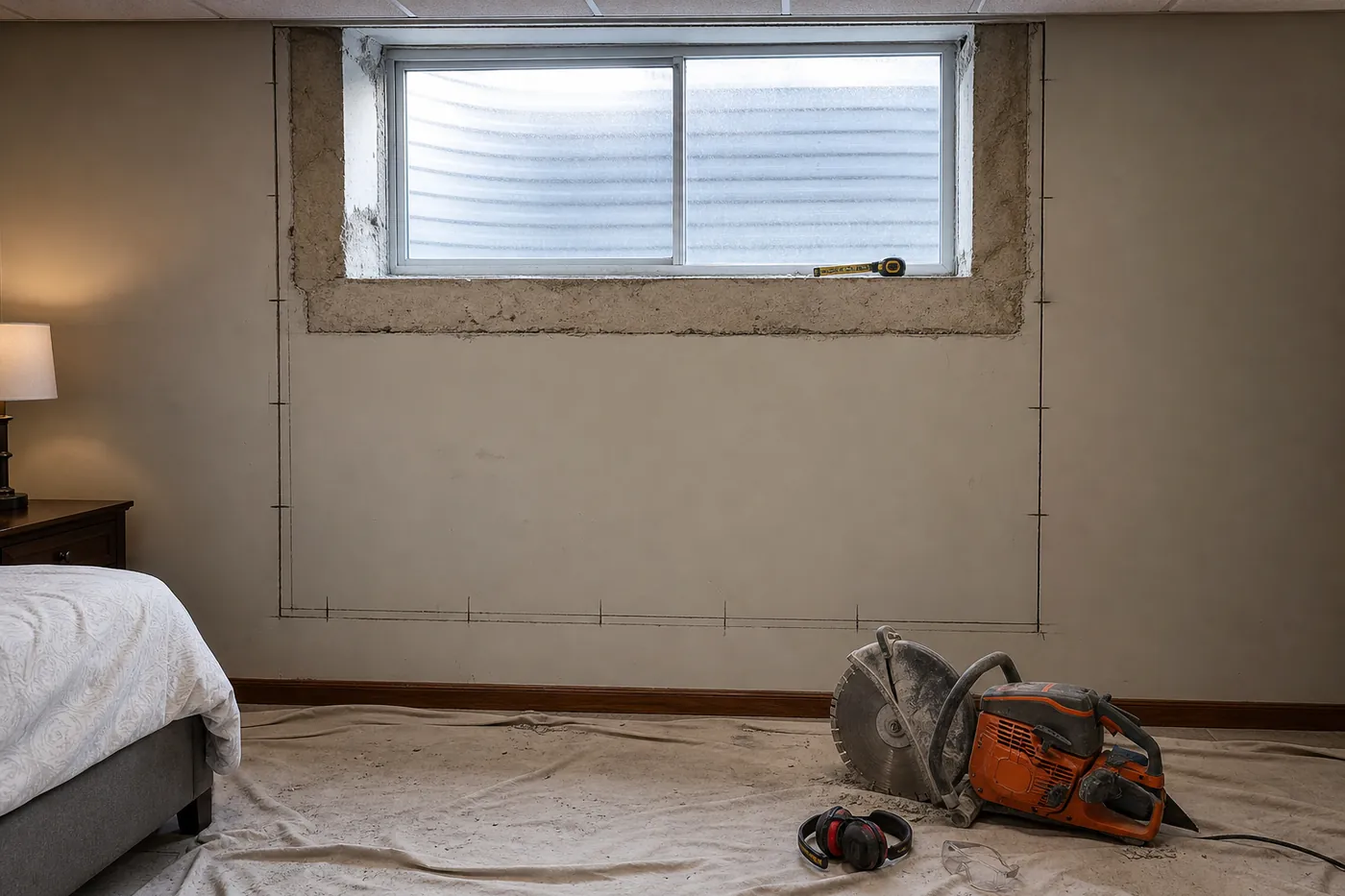
- Cutting new or enlarging old. About 55% of Denver homes were built before 1980 (U.S. Census), and many of their basements start with small, high windows. Widening a window that already sits low enough is a short job. Lowering the sill of a small window near the joists means sawing much more concrete or block and adding support above.
- How deep the well goes. Past 44 in deep the well needs a fixed ladder. Denver's homeowner permits stop at excavations 4 feet deep, and the city's checklist calls for an engineer's stamp on sloped excavations deeper than 4 feet that are steeper than 1.5 to 1.
- Where the water goes. On swelling clay, the well should tie into the foundation drain. Reaching a drain line, or adding one, is often the hidden part of a bid.
- The window itself. Fixr lists prefab casements at $200–$500 and sliders at $150–$700 before labor; This Old House's 2026 survey averaged $529 for a casement and $531 for a slider.
- Landmark review. In a historic district the job needs drawings and labeled photos for Landmark Preservation before the permit.
- Inside finish. Drywall returns, a sill and trim may or may not be in the price.
How does Denver set the permit fee?
Not from a flat price list. Under section 138 of the 2025 Denver Building Code, plan review and permit fees are based on the total valuation of the work, counting labor, materials, profit and overhead. The plan review fee is charged separately and covers the first and second review. The national figures in the table ($50–$200 from Fixr, $100–$500 from This Old House) are only a rough marker for Denver.
Starting early costs more. Work begun without a permit pays double the standard fees, with a $100 minimum, plus an investigation fee equal to that late fee (sections 138.2 and 138.3). Ask whose name goes on the permit and whether the fees sit inside the bid or on top of it.
Where these prices come from
No public record shows what Denver egress jobs actually sell for. The table uses Fixr's egress window installation guide (updated August 29, 2025), Fixr's foundation repair guide (updated January 27, 2026) for the engineer's letter, and This Old House's egress window cost page (updated October 27, 2026), which draws on Fixr. They are national, so treat them as a way to spot a bid far out of line, never as what a Denver installer will charge.
Checking a Denver egress bid line by line
- Which window model is it, and what net clear opening does the maker list for it?
- What will the finished sill height be above the floor?
- How big and how deep is the well, is a ladder included, and where does it drain?
- Who applies for the Denver permit, and who books the inspections?
- If the house is in a historic district, who prepares the Landmark Preservation application?
- Is a Colorado 811 utility locate part of the plan before digging?
- Where does the dug clay go, and how is the yard left?
- Is interior finishing included?
Get the answers and the price in writing, itemized, along with the warranty terms, before you sign.
Cost questions
Does a historic district change the cost of an egress window in Denver?
It adds steps that someone has to pay for. Denver's Landmark Preservation reviews egress windows on every individual landmark and every property in a historic district, and the application needs labeled photos, site plans, elevations and section details. Ask whether the bid covers preparing that application, since approval comes before the building permit.
Is the window well cover part of the price?
Sometimes. Some bids include a cover, others list it as an option. Fixr puts a cover at $120 to $700 supplied and fitted. Denver does not require a permit for well covers or ladders, but any cover over an egress well must still lift or release from inside without a key, a tool or extra force.
What happens if work starts before the Denver permit is issued?
The fees go up. Under the 2025 Denver Building Code, work started without a permit pays double the standard permit fees, with a $100 minimum, plus an investigation fee equal to that late fee. The work must still meet code and pass inspection, so it is cheaper to wait for the permit.
Which basement wall are you thinking about?
A line or two is plenty: a bedroom planned downstairs, a window up by the joists, a well that fills with snow, a crack in the wall. One independent specialist who works in Denver will get in touch to talk it through.